

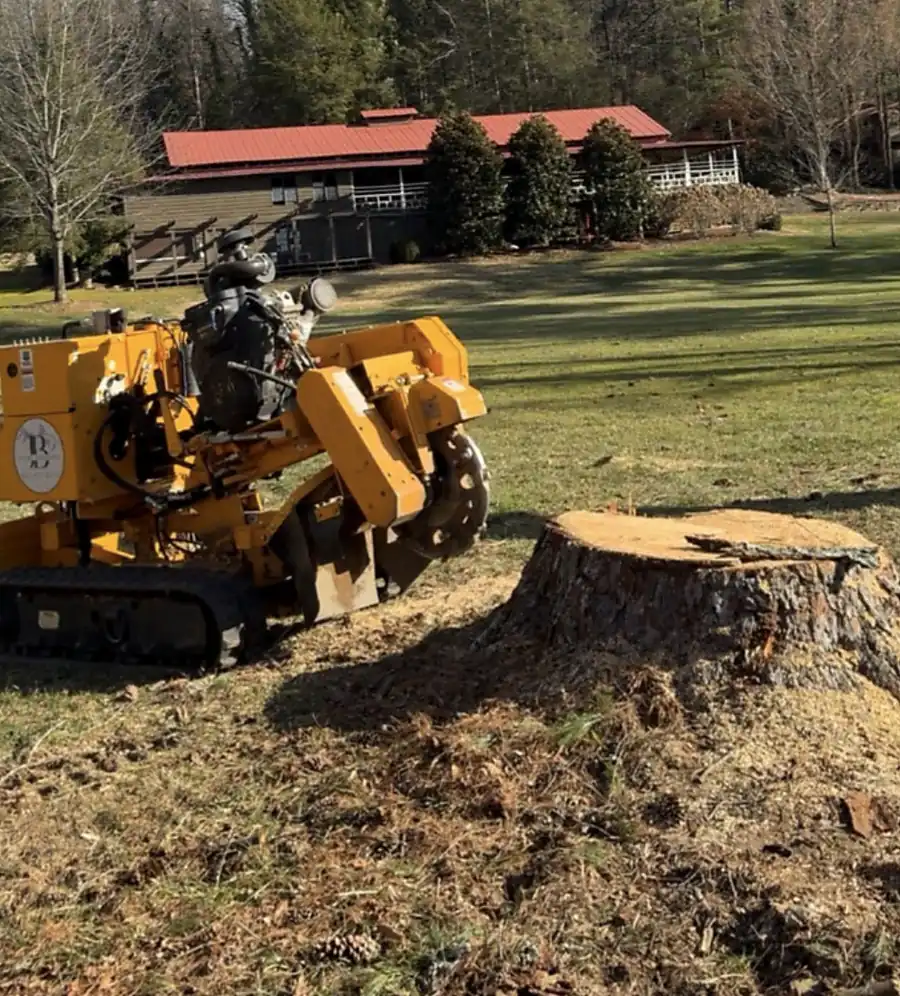
A stump grinder works by spinning a heavy steel wheel fitted with carbide-tipped teeth and swinging it side to side across the stump, so each tooth chips off a small bite of wood. The operator lowers the wheel a little after each sweep and moves forward, turning the stump into a pile of chips and soil until it sits below the ground.
The cutting wheel
Everything happens at one part: a thick steel disc standing on edge, with teeth bolted around its rim. The wheel spins fast in a vertical plane, a bit like a circular saw blade turned sideways to the stump, but it does not slice. Each tooth takes a small chip as it passes, and the stump disappears as a spray of wood. The wheel's weight is part of the design. A heavy wheel keeps turning through hard knots instead of stalling, and it is also why the wheel coasts for a while after the drive is disengaged.
The teeth
The teeth are carbide-tipped, which keeps an edge in wood far longer than plain steel. Carbide is hard but brittle, so a rock or a buried fence staple can chip or snap a tip. That is why the walk-behind manuals tell you to inspect the teeth for sharpness and tightness before every use and replace damaged ones with factory parts. Sharp teeth take clean chips and the machine runs smoothly. Dull or missing teeth rub instead of cut, heat the wood, slow the job and shake the machine. Professional operators treat teeth as a running cost, like fuel.
How power gets to the wheel
Small handlebar grinders run the wheel straight off a gasoline engine through a belt and a clutch. You squeeze a lever to engage the clutch, and one manual notes that a squealing belt or clutch means you are feeding in too hard. Larger machines turn the wheel and move the boom with hydraulics, and hydraulic cylinders swing the wheel sideways and raise and lower it. Grinder attachments for loaders, skid steers and tractors draw that hydraulic power from the carrier. Tracked machines such as Vermeer's add an operator presence control: the wheel will not engage unless the operator's hand is on the lever.
The sweep
The wheel does not bore straight down. It sweeps. On a handlebar machine you pivot the whole grinder on its wheels to swing the cutter left and right. On a hydraulic machine the boom swings it. Each pass shaves a shallow layer off the face, and the operator lowers the wheel a little before the next. The Toro attachment manual gives a quarter inch to two inches per pass depending on the wood, and a walk-behind manual gives half an inch to an inch. Shallow passes keep the engine at speed and the teeth cutting instead of slamming.
How it gets below ground
The wheel hangs out in front of the machine, so it can keep cutting after the stump is level with the soil. The operator works the front edge down, lifts the wheel, moves the machine forward and works down again, chasing the stump below grade in steps. The manuals cap how far the wheel is buried at each position, then call for a move forward, which also prevents undercutting. Wikipedia's summary puts a normal horizontal grinder's reach at roughly the top eight to ten inches of a stump, and Iowa State Extension says professional machines usually take a stump and its big side roots eight to twelve inches down.
Where the stump goes
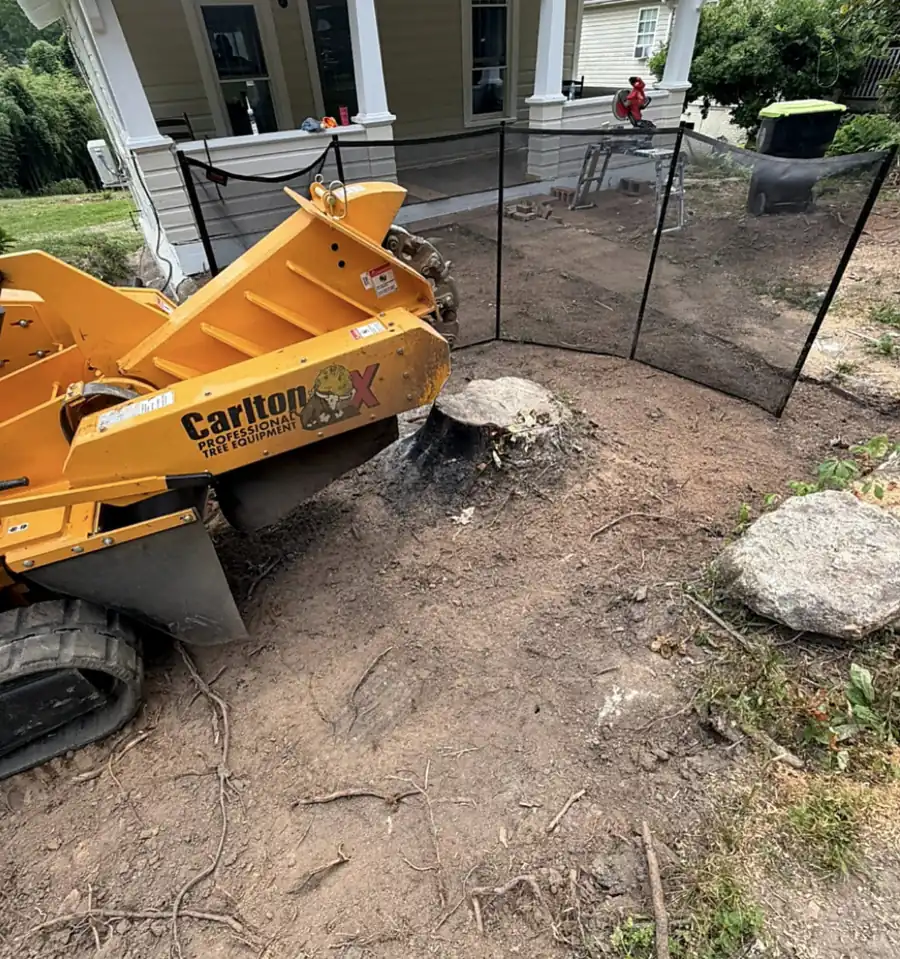
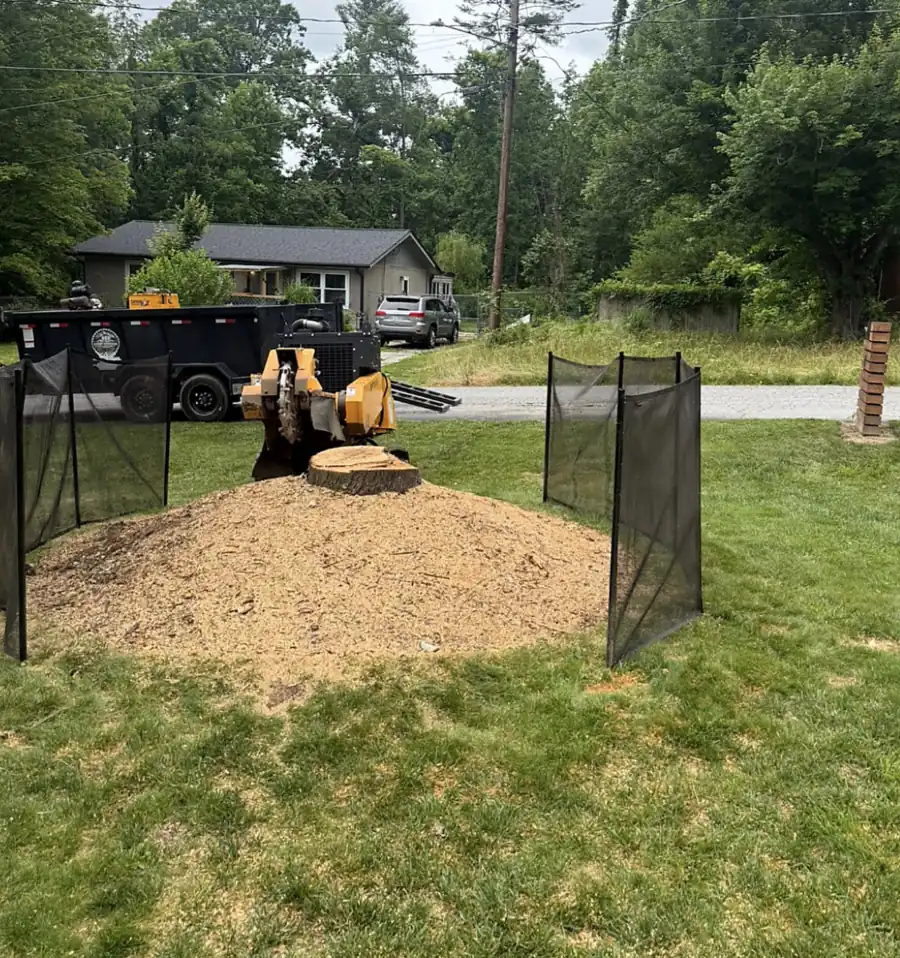
Into the air, then onto the lawn. The wheel throws chips, soil and anything else it meets in an arc, which is why walk-behind manuals set a 75-foot safety zone and why loader attachments carry a chip guard. Many operators also stand mesh screens around the stump. What lands is grindings: shredded wood mixed with soil, always a bigger pile than the stump looked. The roots beyond the cut stay in the ground and rot. What to do with stump grindings covers the pile.
Other designs
Almost every yard grinder works the way described here, with the wheel spinning on a horizontal axle and sweeping across the face. A few other designs exist. Vertical grinders, used mainly in forestry and grounds maintenance, spin on an upright axis and can destroy stumps more than a meter deep. Excavator and skid steer attachments bring the same wheel idea to machines already on a clearing site. Types of stump grinders compares the machines by size and use.
What the machine cannot judge
A grinder will cut whatever is under the wheel: wood, a stone, an irrigation pipe, a cable. It has no idea which is which. The judgment comes from the person running it, who reads the stump before cutting, marks or asks about private lines, watches for wire grown into the trunk, and decides how deep the spot needs to go. Public utility lines get located through 811 before grinding near them, and the owner points out private lines that 811 does not mark. That is most of what separates a clean job from a broken one. See how stump grinding is done on a real yard.
Photos From Real Jobs
Common Questions
Do stump grinders use blades or teeth?
Teeth. A stump grinder's wheel carries a ring of carbide-tipped teeth bolted to its rim, and each one takes a small chip of wood as the wheel spins. There is no blade edge running around the wheel. The teeth wear and chip, especially on stones, and are replaced individually.
Does a stump grinder grind the roots too?
It grinds the stump and the root flare, the thick base where the big roots leave the trunk, and it can cut through surface roots near the stump. It does not chase roots across the yard. Those stay in the soil, die and rot over several years.
Why does a stump grinder throw so much debris?
The wheel spins fast and every tooth flings its chip outward, along with soil and stones it meets. Walk-behind manuals say debris can fly up to 75 feet and bounce off hard surfaces, which is why bystanders, cars and windows are kept back and many operators set mesh screens around the stump.
What to Do Next
Want to see it done on your stump? Take one picture of the stump with a tape or a shovel for size and one of the route in from the street, then call (828) 574-4474 or email them with your town.