

Red clay does not stop a stump grinder, but it changes the timing and the finish: grind when the clay is firm, not soaked, and fill the hollow with real topsoil rather than clay and chips. Clay drains slowly and packs hard, so a hole left full of clay grindings tends to hold water and grow poor grass.
What red clay is, and why it is everywhere
The red ground under so many Piedmont yards is a clay subsoil. The Cecil series, North Carolina's state soil, is the classic example: a sandy loam topsoil over red clay, found across the Piedmont from Virginia into Alabama, the Upstate of South Carolina included. A soil science booklet on Cecil puts it at about 1.6 million acres in North Carolina alone and notes that iron oxides through the profile give it the red color. Much of it was farmed, and erosion stripped the topsoil off a lot of it. That is why so many lots grade straight into red clay a few inches down.
Wet clay and a tracked machine
Firm clay carries a tracked grinder well. Wet clay is another matter. NC State Extension notes that clay particles line up and compact easily, especially when moist, and advises working soil only when it is not excessively wet. On a stump job that shows up as ruts along the route, clay smeared into the lawn, and red mud carried onto drives and walks. A few dry days fix most of it. Tracks treat a dry lawn gently, and a soaked one is worth waiting for, so a wet clay yard may mean moving the date. Matting goes down where the route crosses a drive.
Clay in the grindings
Grindings are always wood mixed with whatever soil the stump sat in. In a clay yard that means red-stained chips with clods of clay through them, and in wet weather a heavy, sticky mound. That changes what they are good for. Clay-heavy grindings stain concrete, so keep them off pale walks and patios. They make a rough mulch at the back of a bed but a poor one by the front door. Raked back into the hollow they settle into a dense plug. If the spot is going to be lawn or a bed, ask for the grindings to be piled or hauled instead.
Why a hollow in clay can turn into a bowl
Clay drains water slowly, because the pores between its tiny particles are small. A Chatham County NC State Extension article puts it simply: clay drains water slowly. Grind a stump out of clay and you leave a hollow with walls that shed little water. Fill it with loose chips and rain runs in and sits there, keeping the wood soggy and the surface soft. Two habits help. Mound the fill above the lawn so water runs off the patch, not into it. And avoid sand as a quick fix. Clemson Extension warns that tilling sand into clay can make it firmer and drain worse.
Filling the hole on a clay lot
Dig out most of the clay and chip mix from the top of the hollow. Fill it with bought or saved topsoil, not more red clay from somewhere else on the lot. NC State Extension observes that topsoil in the Southeast is often only a few inches deep, with acidic clay below it, and Clemson Extension says that on clay or eroded ground, adding up to three inches of topsoil can help a new lawn. Firm the fill lightly, mound it a little, water it and top it up as it drops. Then seed or sod in season. Seeding or sodding over a stump spot is its own guide.
Root balls that come out of clay
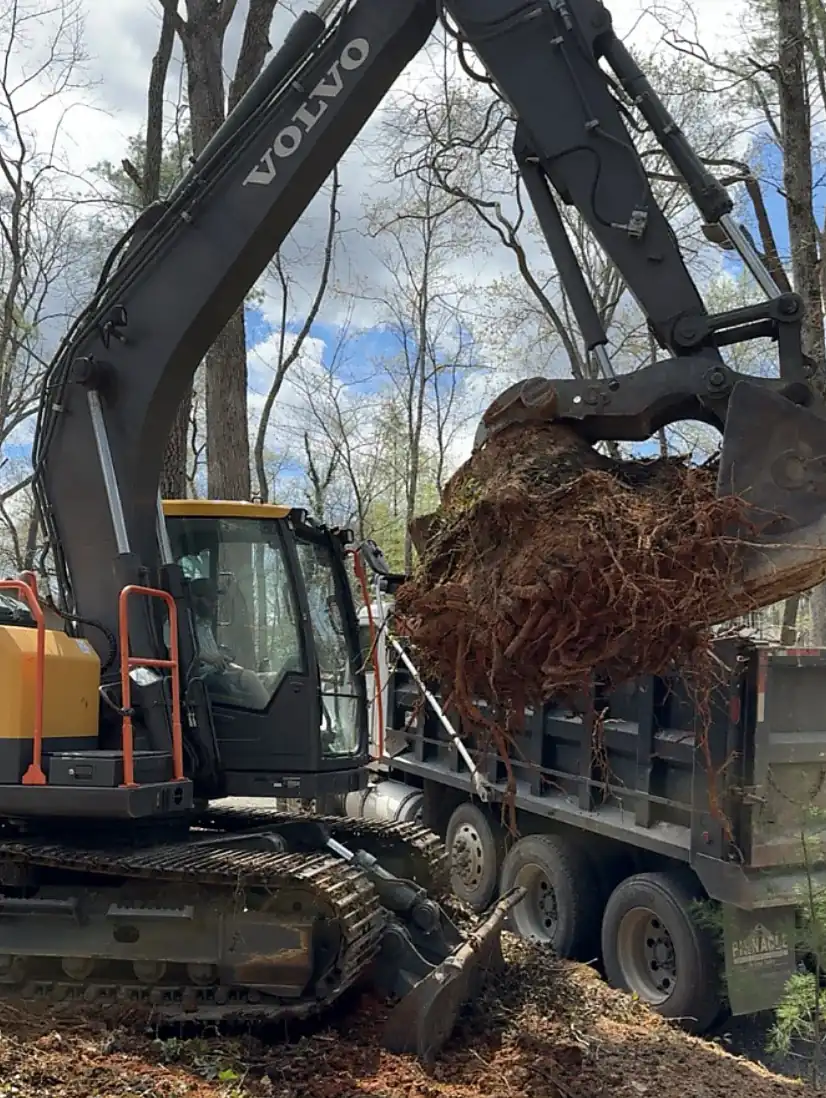
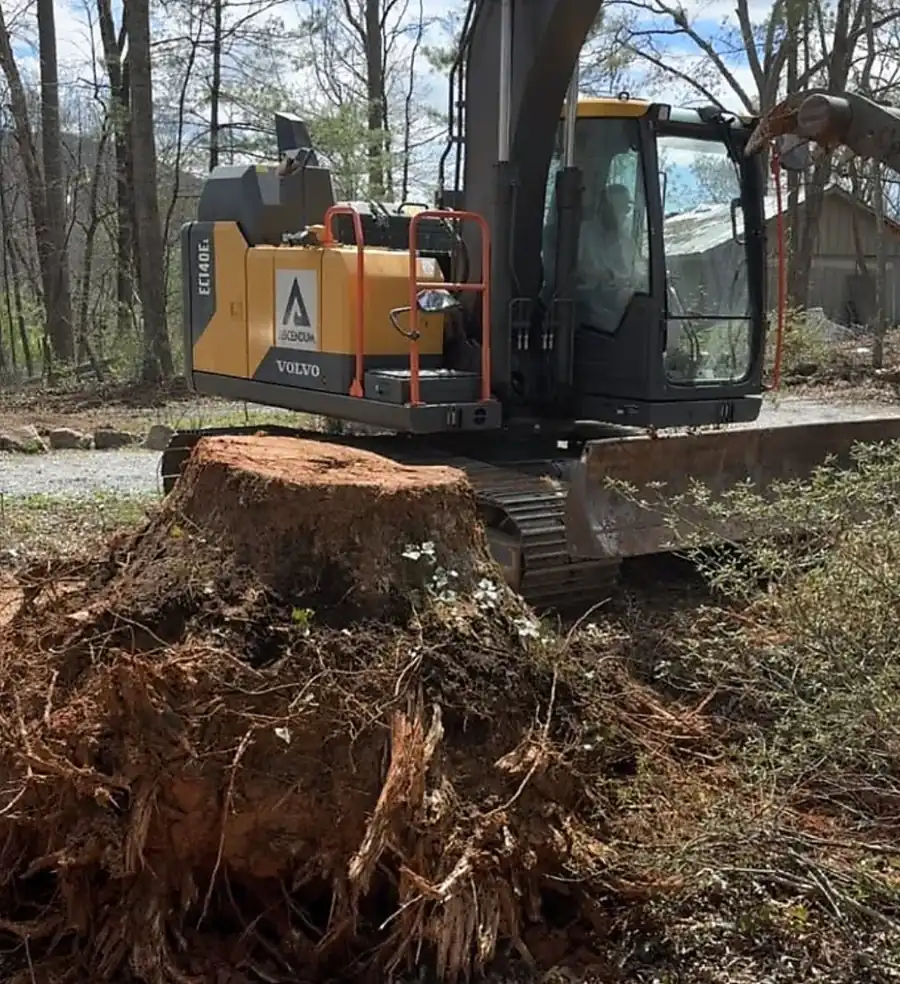
Where a stump has to come out whole, clay makes the root ball heavier than it looks. The clay packs between the roots and clings, so a lifted stump carries a large load of red soil with it. That matters for hauling and for disposal, so ask the disposal site whether soil on the roots is a problem. It also leaves a bigger, more ragged hole to backfill. Full stump removal is the right call when a footing, slab, post or drain is going on the spot. For lawn or mulch, grinding leaves the clay where it is and keeps the job small.
Bare clay on a slope
On a sloped clay yard, the patch where a stump was ground is bare soil, and bare clay washes. A summer storm can carry red silt down the lawn and onto the street. Cover the patch soon after the job: spread the woodier grindings thinly over it, lay straw, or seed and mulch if the season is right. Do not leave a bare mound sitting through a wet spell. Several ground-out stumps on one bank are worth treating as a small erosion job. Stump grinding in wet weather has more on timing around rain.
Photos From Real Jobs
Common Questions
Is it harder to grind a stump in red clay soil?
Not much, if the clay is firm. The wheel cuts wood, not soil, and a tracked machine crosses dry clay easily. The trouble comes when clay is soaked: it ruts, smears and gets tracked around. A few dry days before the job make it a normal grind.
What should I fill a stump hole with in clay soil?
Topsoil, mounded slightly above the lawn so it sheds water as it settles. Take out most of the clay and chip mix first. Do not fill with more red clay, and do not mix sand into clay, which Clemson Extension warns can make it firmer and slower to drain.
Why does water sit where my stump was ground out?
Usually because the hollow is in clay, which drains slowly, and it was filled with loose chips that sit below the lawn. Rain runs into the low spot and stays. Dig out the soggy chips, fill with topsoil mounded a little high, and the patch will shed water instead of collecting it.
What to Do Next
Clay lots grind fine on a dry week. A photo of the stump beside a tape or a shovel, one of the route from the street, and the name of your town will get you a price. Phone (828) 574-4474, and read about the work on the stump grinding page.